


The national health accounts for 2023-24 were published on 15th November 2026, and they paint an interesting picture about India's healthcare spending priorities. Government spending on healthcare has tripled since 2013-14 from 1.30 lakh crore rupees to 4.14 lakh crore rupees1. For an LMIC like India, that's an encouraging statistic. Along with this, we also see the share of out of pocket spending for medical bills dropping from 64.2% of all medical expenditure to 42.7%, which is a good, significant reduction.
Defining priorities
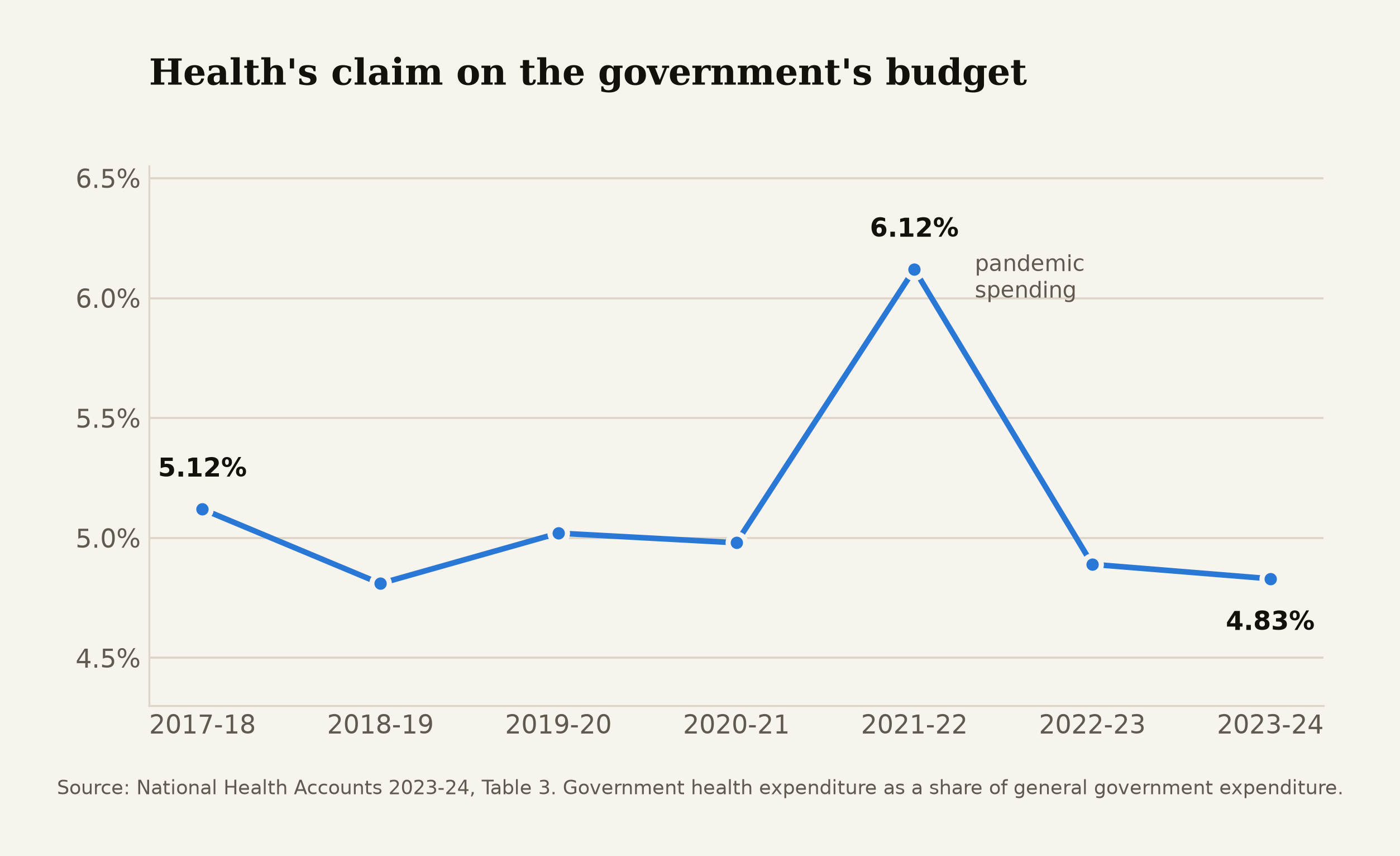
Health as a fraction of all spending, however, fell slightly from 5.12% of all government spending in 2017-18 to 4.83% in 2023-24.2 The centre-state split has moved to 32.1% centre, 67.9% states, down from 41.8% centre in 2021-22 and the centre's lowest share in the seven years this series covers.
Out of the 8.37 lakh crore rupees spent by Indians on healthcare3, only 912 crore rupees4 were spent on early disease detection. In contrast, the amount spent on medicines was 2,52,949 crore rupees, 277 times greater than that spent on early detection.
To give a better sense of scale, the medicines bill rose from 2,43,562 crore in 2021-22 to 2,52,949 crore in 2023-24. That single year increase amounts to 9,387 crore rupees. The single year increase in the medicines bill was 10 times the country's entire early detection budget.
It is important to concede that for a country with limited resources, putting money where the payoff is now rather than some time in the future makes sense. India definitely does invest resources in tried and tested preventive measures. For example, immunisation was at 8,539 crore in 2023-24, which was 9.4 times the early detection line in the same year.5 Given the legacy and effectiveness of India's vaccination programme, the country can definitely finance prevention at scale when it wants to.
If we look at the budget line "healthy condition monitoring" which covers checkups, we find an additional 31,139 crore rupees being spent on regular monitoring of individuals6 which does increase the spending levels on early detection if taken generously. Government spending is just over half of all spending in this category.7 If we add both healthy condition monitoring and early disease detection together, the resultant number is still one eighth of the amount spent on medicines.
Screening vs surveillance
India does have another method to understand disease outbreaks, which is surveillance. India follows the System of Health Accounts (SHA) 2011, an international statistical standard for healthcare accounting. SHA 2011 breaks screening8 and surveillance by the unit of measurement. Screening happens at the individual level, surveillance happens in a community. So a person can be screened for, say, latent TB infection and put on 3HP if required, whereas an outbreak of malaria would mean elevated numbers amongst a target population requiring an area- or community-level intervention.
India spends a large amount on surveillance and disease control. 28,546 crore rupees, to be exact. This allows us to catch outbreaks of malaria, TB, covid-19, and so on and get ahead of them. Infectious diseases have been the historical bane of India's healthcare burden and deservedly have a large share of the spending pie.
A comparison with EU figures is quite instructive. India spends just over twice the EU share on prevention: 8.80% of current health expenditure vs an EU27 average of 3.8%. The differences come down to how it's allocated. Healthy condition monitoring commands a similar share in both reporting units. However, India's share of spending on epidemiological surveillance (38.8% of money spent on prevention) is far greater than the EU's 13% - 15%. On the other hand, the EU spends another 13% of its prevention budget on early disease detection, where India spends only 1.2%.
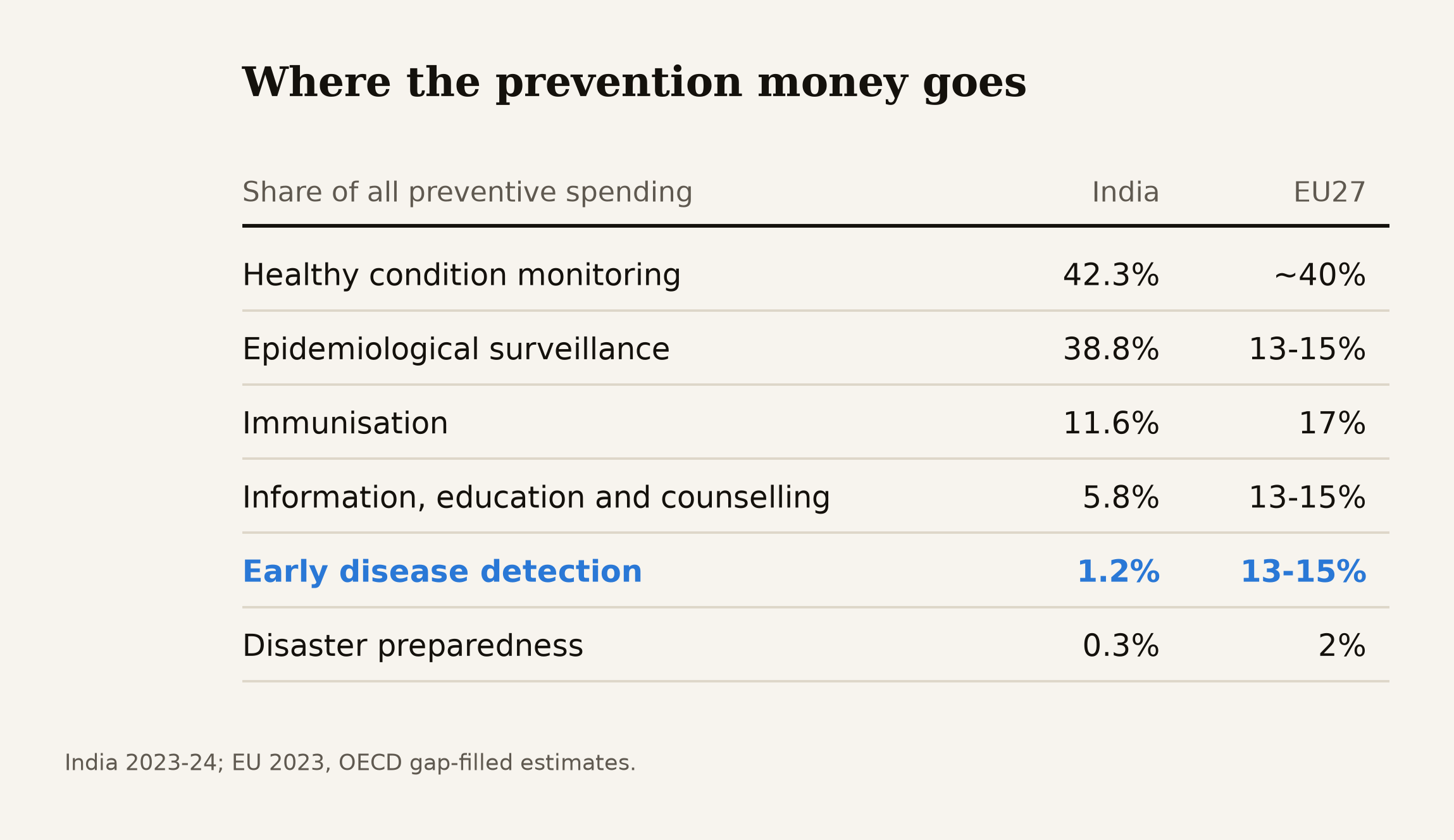
India’s disease profile is partly to blame - India's TB, malaria and HIV programmes are large, they're necessary, and they do a lot of good. However, the 2025 health survey report shows endocrine and cardiovascular ailments overtaking infections while the prevention budget looks exactly like a communicable-diseases portfolio.
The state of early disease detection in India
The government is aware of this shift. In fact, if you look at the trendline, you will find that until 2021-22, early detection in India was essentially philanthropy. Non-profits funded the majority of it. Then in 2022-23, the government arrived and essentially took over, increasing central funding to 781 crore9. In 2023-24, central funding was cut down to 576 crore, and with the states cutting a further 88 crore, government funding for early detection fell from 1,188 crore to 912 crore crore in a single year.
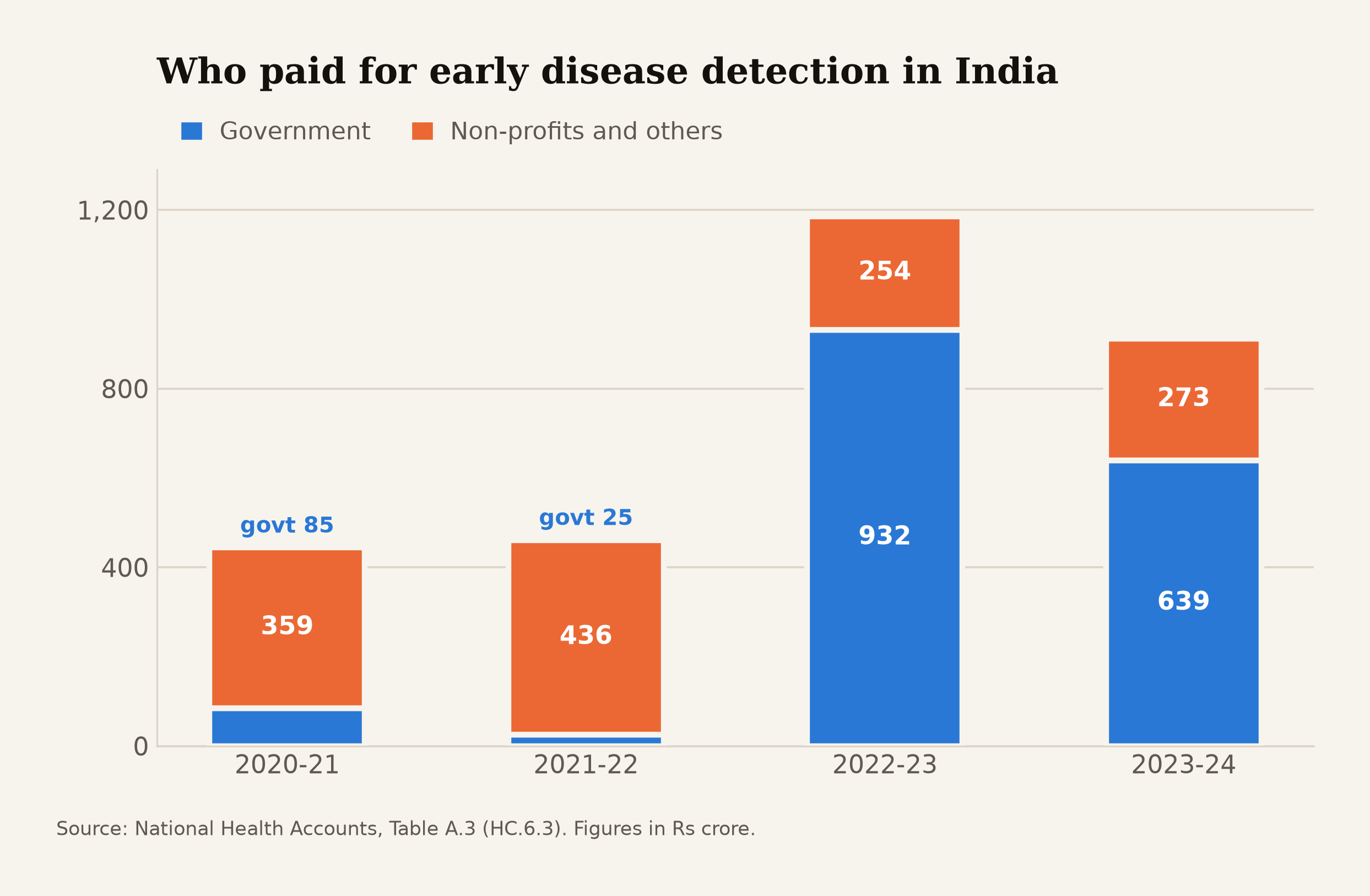
Given the changes in the burden of disease in India, it is that budget number that we need to look at. The burden of non-communicable diseases is rising, and the one function which enables us to find it before the person in question starts to need treatment is one of the smallest line items.
In nominal rupees, that is. Deflated using the GDP deflator implied by the health accounts' own current and constant price series, which works out to 50.2% cumulative inflation over the decade. Adjusting for inflation, the real increase is closer to 2.1 times and the per capita increase is around 1.89 times. The jump, despite being smaller than what nominal headline numbers would indicate, is still substantial.
Healthcare spending rose to a peak of 6.12% in 2021-22, but that was a pandemic anomaly.
This figure includes both government and non-governmental spending. It's roughly 36% government, 48.5% out of pocket, and the remainder a combination of insurance, corporate, and NGO spending. Note that it counts only current spending and leaves out capital spending on buildings and equipment, which is why the government's share here works out to about 3.01 lakh crore rather than the 4.14 lakh crore above: that larger figure includes 1.13 lakh crore of capital spending.
639 crore spent by the government, of which 576 crore came from the centre and 62 crore from the states. The rest came from NGOs and enterprises.
Interestingly, the first comparison I did was in the 2021-22 series, which showed the difference to be 102 times instead of 9.4. After getting over my initial shock, I remembered that was the year everyone was being immunised at scale against COVID-19 and thus discarded it.
e.g. General health checkups, regular dental checkups, regular antenatal checkups, employee medical checkups, and so on.
To be fair to the government, its share has been increasing steadily and has just breached 50% in 2023-24.
Early disease detection, to be exact, which includes things like mammograms and pap smears.
A cursory reading of the data would make one think that non-profits reduced their contributions in 2022-23, but that would be incorrect. The reporting for non-profit contributions changed that year, so the numbers before and after aren't comparable.